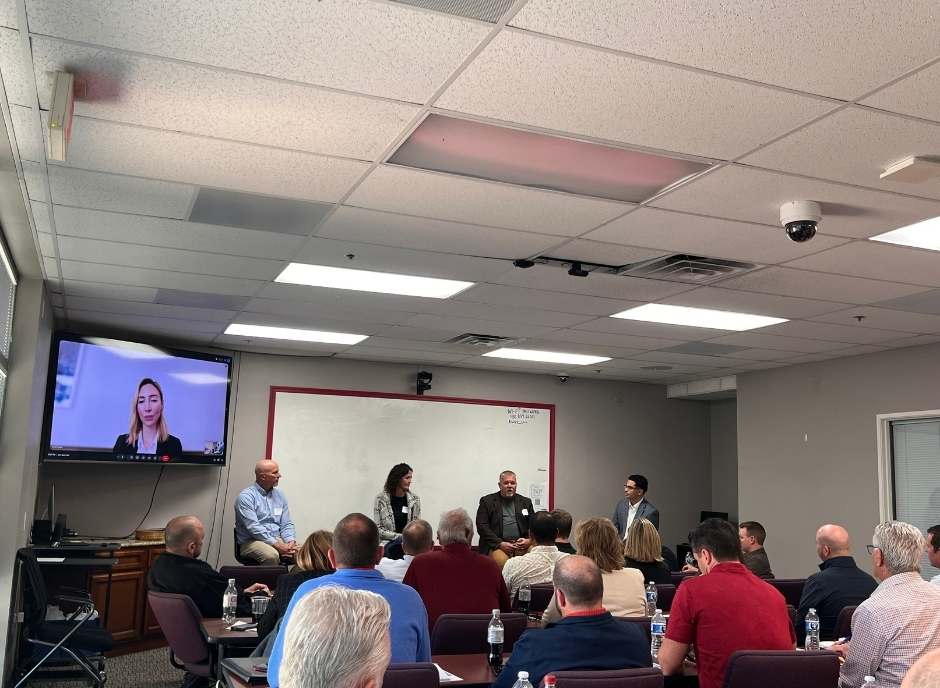
At our Lunch & Learn, the panel discussion added an important layer to the earlier presentations: it moved the conversation from theory and market trends into the real-world decisions operators, lenders, builders, and technology partners are making every day.
The overall theme was clear: today’s storage market is less forgiving, more operationally demanding, and much more focused on what is real, provable, and executable. Whether the topic was technology, financing, construction, bad debt, or acquisitions, every panelist came back to the same core idea: the winners in this market are the ones who can operate efficiently, validate their assumptions, and adapt quickly.
With perspectives from lending, construction, operations, and technology, the panel showed that getting from NOI to exit is no longer about one silver bullet. It is about alignment across the entire asset.
Technology is no longer optional, but it still has to work in the real world
One of the first topics the panel tackled was technology and automation, and Alonna Ross put it plainly: the most important technology for operators today is a system that can take a prospect from lead to lease with as little friction as possible.
That means more than just having management software. It means having a platform that allows a customer to:
If a tenant still has to jump through hoops just to rent a unit, operators are losing business.
But the panel also made an important distinction: just because remote leasing is essential does not mean human interaction is obsolete.
Ray McRae brought that point home from the operator side. In his view, automation matters, but operators still need a live person available somewhere in the process. Storage is still a human business. Customers are often moving through stressful life events, and not every problem can be solved by a kiosk, call tree, or chatbot. Ray noted that when a customer gets frustrated and drops off mid-process, the technology did not save labor costs—it lost revenue.
That became one of the biggest connecting themes of the panel: technology should remove friction, not remove service.
The panel also pointed out that successful unmanned or hybrid models depend on execution details that are easy to overlook. Alonna mentioned a surprisingly simple but common issue: poor cell connectivity at the property. If a tenant arrives on-site and cannot access the leasing flow from their phone, the whole remote system falls apart. It is a small issue with a big operational consequence.
The best tech strategy is the one that matches the property and the market
Tarek Williams added a builder’s perspective that grounded the tech conversation in reality. He noted that storage technology, like everything else, goes through phases. At one point, individual unit alarms were the trend. Then it was camera-heavy systems. Now the market is leaning into phone-based access, Bluetooth, and smart-entry platforms.
But not every property needs every tool.
His point was practical: each operator should evaluate what actually fits their market, customer base, and operating model. Some properties may justify more advanced systems, while others can still perform well with simpler access control and surveillance. In other words, technology is necessary—but it is not one-size-fits-all.
That matched what Anna Siradze shared from the lending side. Lenders may give credit to operational efficiencies created by hybrid or tech-enabled models, but only when those efficiencies are backed up with data. If a borrower claims they can reduce payroll and management costs because of a hybrid setup, the lender wants proof: historical performance, comparable facilities, and a track record showing the model actually works.
Again, the pattern was consistent: not just strategy, but proof.
Bad debt is now part of the underwriting story
Another strong thread in the conversation was bad debt and delinquency.
Alonna Ross explained that many operators, especially larger ones operating across multiple states, have historically allowed delinquent tenants to sit too long before moving to auction. In some cases, they were timing all their states around the most restrictive lien law in their portfolio, which meant other facilities were carrying bad debt longer than necessary.
That is starting to change.
Operators are tightening up, moving through lien timelines faster, and trying to regain rentable units more quickly. The shift is partly driven by necessity: after the unusually strong demand environment of the COVID years, operators want those units back in inventory and do not want bad debt piling up.
Anna added an important financing perspective here. Lenders are increasingly looking at bad debt not just as an operational issue, but as a signal tied to rental strategy. If an operator is projecting stronger rental rates, but delinquency and bad debt are climbing alongside rent pushes, it raises questions about how sustainable those rates really are. In that sense, bad debt becomes a test of whether revenue growth is actually sticking.
That ties directly back to the broader Lunch & Learn theme around durable NOI. If income is being pushed aggressively but tenant behavior says otherwise, lenders and buyers are going to notice.
Ancillary income matters, but it has to be documented
One of the more practical parts of the panel centered on ancillary income—tenant insurance, admin fees, merchandise, parking, and similar revenue streams.
Ray shared an example from a recent acquisition where his team found upside simply by implementing basics the seller had never fully captured: tenant protection plans, boxes and locks, admin fees, and insurance purchasing power. In some value-add deals, those overlooked income streams can materially improve NOI.
Alonna emphasized how under-appreciated tenant protection revenue still is. Operators can often negotiate better revenue shares with providers, and at some facilities the participation economics are meaningful. It is not flashy income, but it adds up.
Anna confirmed that lenders do give credit for ancillary income, but the same rule applies: it must be supportable. If a borrower is projecting income from parking, protection plans, or other add-ons, lenders want to see that the assumptions are realistic, measurable, and tied to actual performance.
Once again, the panel kept circling back to the same point: real numbers win.
Good deals are still out there, but due diligence is doing more heavy lifting
The conversation around acquisitions and value-add opportunities was especially revealing.
Ray McRae shared that his group is focused almost entirely on buying value-add deals today rather than building from the ground up. What they look for is not just upside on revenue, but opportunity on both sides of the ledger—income and expenses.
His example was a perfect reminder that value-add often hides in plain sight. In one recent deal, his team found thirty-one units that were not even on the rent roll, effectively uncovering additional rentable square footage the seller did not know existed. Those are the kinds of discoveries that can change the economics of an acquisition.
But the flip side is that due diligence is more important than ever. Ray also described another deal that fell apart because the property was marketed with excess land that was supposedly expandable, but during due diligence the buyer learned the city no longer wanted additional storage approved on-site. The value-add story was not real, so the deal died.
Alonna said she has seen the same pattern from the software and transition side: transactions move forward, only for the buyer to dig into the numbers and realize the story does not match the records. Anna echoed that from capital markets, pointing to unrealistic expectations and a widening gap between buyer and seller assumptions as one of the most common reasons deals stall or fail.
That may have been the cleanest summary of the current market: deals are not falling apart because nobody wants storage. They are falling apart because the facts are catching up to the story.
Design decisions still shape NOI long after construction is complete
Tarek Williams brought a valuable perspective on how design and construction choices continue to affect operations and NOI well after opening day.
His advice started at the beginning: hire self-storage designers with real storage experience. A talented architect from another product type may eventually figure out storage, but that learning curve can be expensive if you are the developer paying for it. Even then, Tarek stressed that the developer cannot be hands-off. Designers are bringing experience shaped by previous clients, and not every operating philosophy fits every market. Developers need to stay actively involved so the design reflects their market, climate, and operating strategy.
He also called out common issues that can hurt performance later:
From the acquisition side, Ray added examples of older facilities with narrow aisles, dead ends, poor turnaround space, and other functional issues that can never really be fixed. Those mistakes become permanent friction.
On the construction side, Tarek said the biggest project “blowouts” today are often not in the building itself, but in the timeline and utility process: permitting, approvals, water, sewer, power, data connectivity, neighboring properties, and municipal hurdles. For conversions, structural load is a major issue. An old office or retail building may look like a good storage candidate, but if the floor was not designed for storage loads, the structural work can become substantial.
The underlying lesson was simple: bad assumptions in design become expensive truths later.
Bridge-to-bridge financing is real, and the easy refi is gone
One of the most candid parts of the panel came when Darsh asked about bridge debt and the growing amount of real estate loans coming due.
Anna Siradze explained that bridge-to-bridge financing has become much more common, particularly for investments made in the 2021–2022 window. Those deals were often underwritten with cheaper debt, higher leverage, and more optimistic assumptions. Since then, fundamentals and lending standards have shifted. What was once a 70%–75% LTV environment may now be a 60%–65% LTV environment.
That change creates a very real capital stack problem.
Borrowers who expected a future value bump and an easy takeout are now sometimes facing recapitalizations, lower proceeds, or the need to bring fresh cash to the table. Anna made it clear that the “extend and pretend” phase is largely over. The market is now forcing a clearer reset.
That comment connected strongly to everything said earlier in the day by the presenters: today’s market is cash-flow driven, disciplined, and less willing to underwrite hope.
The human element is still a competitive advantage
One of the most useful moments in the Q&A came when Ray was asked why his team had moved away from a more fully remote management model.
His answer was refreshingly straightforward: because people still matter.
Yes, technology can save labor costs. Yes, automation can improve convenience. But when operators actually look at where deals fall off, many lost rentals trace back to a missing human touch at a key moment. A frustrated customer who cannot complete a rental is not a labor savings story—it is lost income.
Ray’s view was not anti-technology. It was more balanced than that. Use the tools, but make sure there is still a trained person who can step in, answer questions, and help close the transaction.
That sentiment quietly tied together the whole panel. In a market increasingly driven by automation, data, and tighter underwriting, the panelists kept reminding the room that storage is still a relationship business. The operators who succeed will use systems to improve execution, not to remove accountability.
Final takeaway: execution is the new edge
If there was one big takeaway from the panel, it was this: the next phase of self-storage belongs to operators and investors who can execute across the entire asset.
Not just market it.
Not just finance it.
Not just build it.
Not just automate it.
Execute it.
The panelists approached the topic from different angles, but their connecting points were remarkably aligned:
In other words, the market is no longer rewarding operators for simply having a story. It is rewarding them for having a system.
And that may be the strongest theme of all from NOI to Exit: in today’s storage market, credibility, discipline, and execution are what carry a deal from underwriting to outcome.
If you're interested in connecting on the current market or to talk through your facility, connect with us.