
For most of the last decade, "value-add" in self-storage followed a simple formula: buy an under-occupied facility from a tired owner, fix the signage, put up a website, and let a rising rental market do the rest. Street rates climbed, occupancy filled in, and nearly any competent operator could show a meaningful NOI lift within 24 months.
That formula doesn't work in 2026, at least not on its own. Across Phoenix, Las Vegas, and Salt Lake City, street rates have spent the past few years recovering from the post-pandemic reset, new supply from the 2021–2024 development wave is still being absorbed in several submarkets, and buyers have become far more disciplined about what they'll pay for "upside." The market tailwind that used to carry mediocre execution is gone.
Value-add still exists. But the levers that produce real, underwritable NOI growth have shifted. Here's what's actually working, what isn't, and what it means for owners thinking about a sale in the next 12 to 36 months.
Why the Old Playbook Stopped Working
The classic value-add thesis relied on two things happening at once: occupancy gains and street rate growth. When both move in your favor, revenue compounds quickly. When street rates are flat or competitive pressure forces move-in specials, occupancy gains alone produce a much slower revenue curve.
Southwest markets felt this more acutely than most. Phoenix and Las Vegas were among the most active development markets in the country during the last cycle, and newly delivered facilities in lease-up routinely price aggressively to hit occupancy targets. An owner trying to raise street rates next to a new Class A facility offering a first month free is fighting the wrong battle.
Meanwhile, the buyer pool has changed how it evaluates upside. Institutional buyers and REITs such as Public Storage, Extra Space Storage, and CubeSmart underwrite from their own operating platforms, which means they already assume they can capture much of the operational upside themselves. They aren't inclined to pay a seller for it. Private and DST buyers, facing higher borrowing costs than the 2020–2021 era, are underwriting to in-place cash flow and haircutting pro forma projections heavily.
The result: the value-add that matters today is the value-add you can prove on a trailing basis.
Lever 1: In-Place Rate Management
The single largest NOI driver for stabilized and near-stabilized facilities is no longer street rate. It's the rate paid by existing tenants.
Most mom-and-pop facilities have a large share of long-tenured customers paying rates well below current market, sometimes 20% to 40% below. Existing customer rate increases (ECRIs), managed systematically, close that gap without the marketing cost or vacancy risk of replacing a tenant.
The operators doing this well share a few habits:
Revenue management platforms such as Silo, StorFront, and Apptis have made this far more accessible to independent operators than it was five years ago. For many independents, a disciplined ECRI program is the highest-return, lowest-capital initiative available.
The key for sellers: buyers will credit rate increases that are already reflected in the rent roll and the T12. They will not pay much for a spreadsheet showing what rents could be.
Lever 2: Closing the Gap Between Physical and Economic Occupancy
A facility reporting 92% physical occupancy may be collecting on far less once you account for concessions, below-market rents, delinquency, and write-offs. That gap between physical and economic occupancy is where a surprising amount of NOI hides.
Three areas tend to produce the fastest gains:
Delinquency and lien enforcement. Facilities that don't consistently follow their state's lien process, whether Arizona, Nevada, or Utah, end up carrying tenants who occupy units without paying. Tightening collections, automating late notices, and moving delinquent units through the lien and auction process on schedule converts dead units back into revenue-producing inventory.
Concession discipline. Move-in specials have a place in lease-up, but many stabilized facilities keep running them out of habit. Every concession offered to a tenant who would have rented anyway is lost revenue.
Fee enforcement. Late fees, administrative fees, and lien fees that exist on paper but are routinely waived produce nothing. Consistent enforcement typically shows up in the NOI within a few months.
Lever 3: Ancillary Income That Buyers Actually Credit
Ancillary revenue used to be treated as a rounding error. Today it's a legitimate line item, and buyers increasingly look for it.
Tenant protection or insurance programs are the most significant. A facility that requires protection coverage at move-in and participates in the revenue share can generate meaningful income per occupied unit per month. Many independent owners either don't offer a program or make it optional, leaving substantial revenue unclaimed.
Other ancillary sources worth evaluating include administrative fees at move-in, retail merchandise such as boxes, locks, and packing supplies, and truck rental partnerships where the site and zoning allow.
Buyers will scrutinize ancillary income for sustainability, so it helps to have at least 12 months of consistent history before going to market.
Lever 4: The Expense Side
Value-add conversations tend to focus on revenue, but in a flat rate environment the expense line often produces the more reliable gains.
Payroll and management structure. Staffing is typically the largest controllable expense. Hybrid and remote management models, with kiosks, online rentals, smart access, and centralized call handling, allow many facilities to reduce on-site hours without hurting customer experience. The tradeoffs are real and depend on facility size and market, but for smaller properties the savings can be significant.
Property taxes. Tax treatment varies meaningfully across the three states. Arizona limits annual growth in limited property value for most properties, Nevada's partial abatement caps annual tax increases, and Utah has no comparable cap, making assessment review more important there. Regardless of state, owners who have never challenged an assessment should at least have it reviewed. Buyers will also reassess the property at sale, so understanding post-sale tax exposure is part of pricing correctly.
Utilities. In Phoenix and Las Vegas, where climate-controlled space runs cooling loads for much of the year, LED retrofits, HVAC upgrades, and rooftop solar can materially reduce operating costs. Solar in particular has a strong fit with the Southwest's sun exposure and large, flat storage rooftops.
Insurance. Premiums have risen sharply across commercial real estate. Re-bidding coverage and reviewing deductible structures is a routine but frequently neglected exercise.
Lever 5: Digital Capture and Online Rentals
Most storage customers begin their search online, and a growing share now complete the rental without ever speaking to anyone. A facility without true online rental capability, a well-maintained Google Business Profile, and consistent reviews is losing customers before they ever see the property.
This isn't about expensive marketing campaigns. It's about conversion infrastructure: accurate unit availability online, real-time pricing, a frictionless checkout, and responsive follow-up on inquiries. Facilities that close these gaps often see improved lease-up velocity and reduced reliance on move-in concessions, both of which show up in NOI.
Lever 6: Physical Improvements That Pay (and Ones That Don't)
Capital spending is where value-add plans most often go wrong. The question isn't whether an improvement makes the facility look better. It's whether it produces rent the market will pay and a buyer will credit.
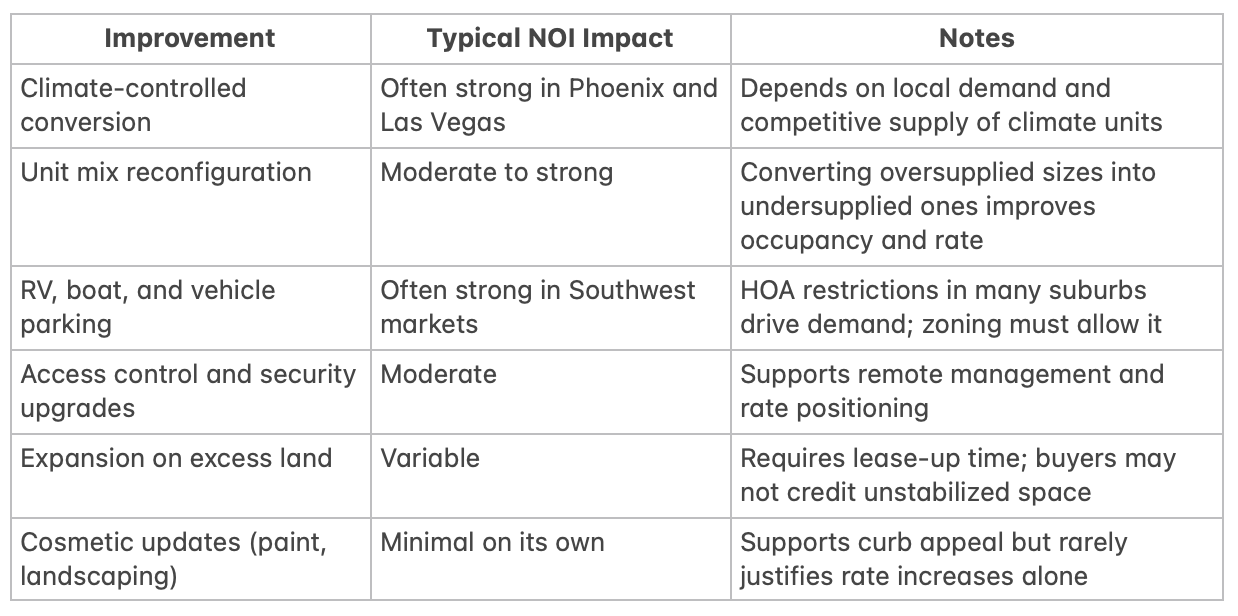
Unit mix deserves special attention. Many older facilities were built with a mix that no longer matches demand. If 10x10s sit at 97% occupancy while 10x30s linger at 75%, reconfiguring even a portion of the larger units can lift both occupancy and revenue per square foot with modest capital.
How Buyers Are Underwriting Value-Add in 2026
Understanding how buyers think is essential for any owner deciding whether to execute improvements before a sale or sell the opportunity to the next owner.
Buyers today generally:
The math behind executing first is straightforward. Consider a facility that increases NOI by $60,000 annually through a combination of ECRIs, protection plan income, and delinquency cleanup. At a 6.0% cap rate, that's roughly $1 million in added value. If the owner sells before executing, a buyer might credit a fraction of that upside, if any, since they'll assume they can capture it themselves.
That said, executing isn't always the right answer. Initiatives that require substantial capital, long lease-up periods, or entitlement risk, such as expansions, may be better presented as opportunity to a buyer than pursued in the final years of ownership. The right approach depends on the owner's timeline, capital position, and tolerance for execution risk.
The Seller's Takeaway
The value-add opportunities that matter most today are operational rather than market-driven. They're found in the rent roll, the collections process, the expense ledger, and the website, not in waiting for street rates to climb.
For owners considering a sale in the next few years, the most valuable question isn't "what is my facility worth today?" It's "what could my T12 look like in 18 months, and what will buyers pay for it?" Owners who answer that question early, and act on the low-capital, high-return levers first, give themselves the strongest possible position when they go to market.
Gorden Group advises self-storage owners across Arizona, Nevada, and Utah on exactly these decisions: which improvements to execute, which to leave for the buyer, and how to time a sale to capture the full value of the work already done. If you're weighing an exit, a conversation now can shape the outcome later.
If you want to talk through your property, Connect with the Gorden Group or request a property valuation